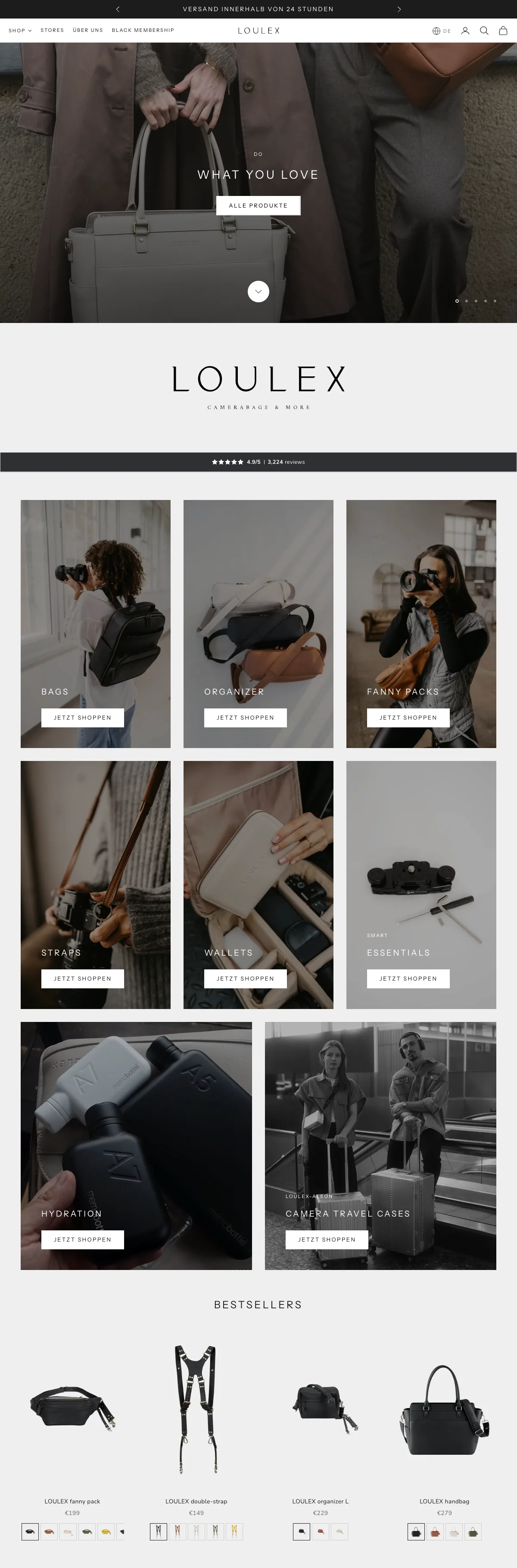
Starting point
The store sells in seven languages. Translation happened from the outside: a service sat in front of the shop as a layer and swapped the text on the way out. That cost 299 € a month, and Shopify itself knew nothing about those translations. They could only be maintained in the other system.
On top of that, an app stack grown over the years for features a theme can do itself: page builders, tabs, an announcement bar, cross-selling, a consent banner, a tracking script. Every app adds its own scripts to every page, costs money each month and makes the next theme update less predictable.
What we built
Apps out, features in. Cross-selling now sits directly in the product page and the cart, product details are written out instead of hidden behind tabs, the announcement bar and content pages are ordinary theme sections, consent runs through Shopify's own banner, and newsletter sign-up goes straight to the mail service's API.
The theme lives in a repo. The live theme is versioned in a repository, every LOULEX customization is marked in the code and can be compared against the vendor version. Content the team edits in the theme editor comes back into the repo automatically every day.
The translation bot. Once an hour: check what is missing or outdated, translate in small batches, verify, write, report. The glossary holds brand and domain terms and defines what is never translated. The checks are strict where it hurts: HTML and Liquid building blocks must stay untouched, and so must links, numbers and placeholders. Anything suspicious goes into quarantine instead of into the shop. If findings pile up, the run stops.
Traceable and reversible. Every run writes a log with the previous values, every change goes out by email, and a rollback takes a whole run back. Fields the team has corrected in the Shopify admin stay untouched.
What the bot doesn't touch. Legal texts, page addresses, email templates, shipping copy, image descriptions. The source stays German, maintained in the Shopify admin.
Result
- Monthly licence cost is gone: 299 € a month for translation, plus roughly 60 € for the apps we replaced. By our projection, the rebuild costs less than the old setup after about nine months.
- Six apps removed. Their features now run in the theme, without extra scripts on every page.
- Seven languages as native Shopify translations, roughly 14,000 words per language, maintained from the German source.
- Faster and technically cleaner. Without the app scripts the shop loads noticeably faster, and its Ahrefs site audit score is three times what it was before.
- Bounded, not open-ended. The bot processes at most 5,000 words and 300 fields per hour. That keeps cost predictable and stops a single mistake from hitting the whole catalog.
Takeaway
Translating is the easy part. The difference sits before and after it: in the glossary that protects brand terms, in the checks that catch broken placeholders, and in the log that lets you take a run back.
And apps are convenient, but their price isn't only on the invoice. It's also in the loading time and in the technical health of the site.